Text Summarization
 Active
PI: Nisansa de Silva
We propose to advance automatic summarization and generation techniques, with a focus on aspect-aware methods that capture fine-grained information and sentiment within concise textual representations.


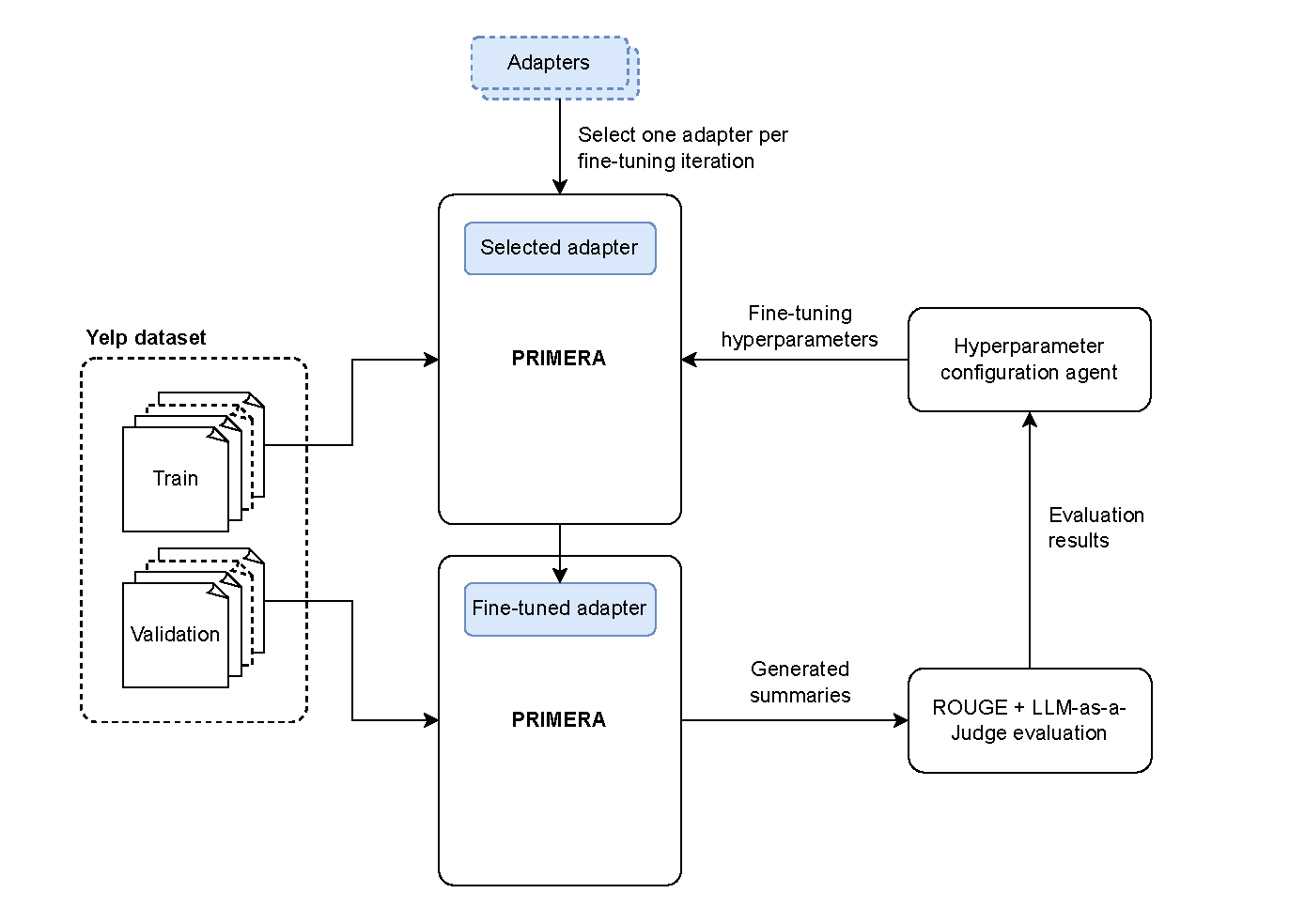
This study explores adapter-based fine-tuning to enhance the PRIMERA model for opinion summarisation. PRIMERA, a state-of-the-art multi-document summarisation (MDS) model, exhibits strong transfer potential owing to its pre-training on large-scale MDS corpora. Leveraging adapter architectures, this work demonstrates substantial improvements when extending PRIMERA to opinion summarisation through parameter-efficient fine-tuning. In addition, an LLM-based evaluation paradigm is introduced using the DeepEval framework, enabling semantic and sentiment-aware assessment beyond lexical-overlap metrics such as ROUGE. To improve training efficiency, an agentic optimisation framework is proposed, where evaluation reasoning guides iterative adapter configuration, reducing fine-tuning cycles while maintaining performance. Results show that adapter-augmented PRIMERA surpasses the opinion summarisation baseline ADASUM, establishing a reproducible, interpretable, and computationally efficient path for low-resource MDS. Overall, this work highlights how adapter-based fine-tuning and reasoning-guided optimisation together advance both performance and applicability in opinion summarisation.
Keywords: Natural Language Processing | Machine Learning / Deep Learning | Multi-Document Summarisation | Pre-Trained Models | Opinion Summarisation | Adapters | LLM |
@inproceedings{hewapathirana2026adapter,
  title={{Adapter-Based Multi-Document Summarisation: Opinion Summarisation Use Case}},
  author={Hewapathirana, K M and de Silva, Nisansa and Athuraliya, C D},
  booktitle={Proceedings of the 18th International Conference on Agents and Artificial Intelligence - Volume 4: ICAART},
    year={2026},
    pages={3018-3027},
    publisher={SciTePress},
    organization={INSTICC},
    doi={10.5220/0014349400004052},
    isbn={978-989-758-796-2},
    issn={2184-433X},
    abstract={This study explores adapter-based fine-tuning to enhance the PRIMERA model for opinion summarisation. PRIMERA, a state-of-the-art multi-document summarisation (MDS) model, exhibits strong transfer potential owing to its pre-training on large-scale MDS corpora. Leveraging adapter architectures, this work demonstrates substantial improvements when extending PRIMERA to opinion summarisation through parameter-efficient fine-tuning. In addition, an LLM-based evaluation paradigm is introduced using the DeepEval framework, enabling semantic and sentiment-aware assessment beyond lexical-overlap metrics such as ROUGE. To improve training efficiency, an agentic optimisation framework is proposed, where evaluation reasoning guides iterative adapter configuration, reducing fine-tuning cycles while maintaining performance. Results show that adapter-augmented PRIMERA surpasses the opinion summarisation baseline ADASUM, establishing a reproducible, interpretable, and computationally efficient path for low-resource MDS. Overall, this work highlights how adapter-based fine-tuning and reasoning-guided optimisation together advance both performance and applicability in opinion summarisation.},
  misc={https://www.scitepress.org/Papers/2026/143494/143494.pdf,NLP:ML,https://goo.gl/iY6aTr}
}
ActivePI: Nisansa de Silva
We propose to advance automatic summarization and generation techniques, with a focus on aspect-aware methods that capture fine-grained information and sentiment within concise textual representations.