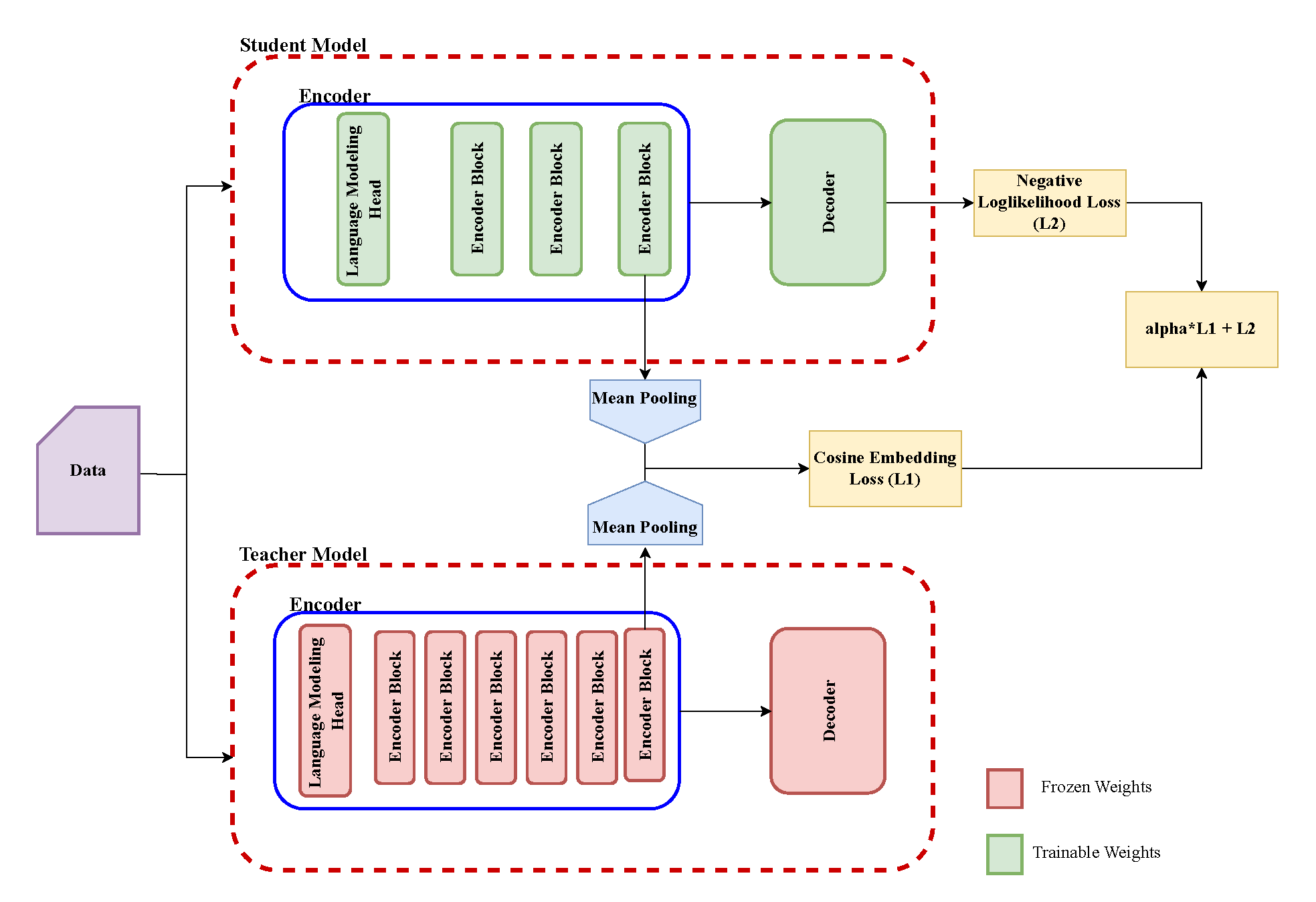
Multi-domain adaptation in Neural Machine Translation (NMT) is crucial for ensuring high-quality translations across diverse domains. Traditional fine-tuning approaches, while effective, become impractical as the number of domains increases, leading to high computational costs, space complexity, and catastrophic forgetting. Knowledge Distillation (KD) offers a scalable alternative by training a compact model using distilled data from a larger teacher model. However, we hypothesize that sequence-level KD primarily distills the decoder while neglecting encoder knowledge transfer, resulting in suboptimal adaptation and generalization, particularly in low-resource language settings where both data and computational resources are constrained. To address this, we propose an improved sequence-level distillation framework enhanced with encoder alignment using cosine similarity-based loss. Our approach ensures that the student model captures both encoder and decoder knowledge, mitigating the limitations of conventional KD. We evaluate our method on multi-domain German-English translation under simulated low-resource conditions and further extend the evaluation to a bona fide low-resource language, demonstrating the method's robustness across diverse data conditions. Results demonstrate that our proposed encoder-aligned student model can even outperform its larger teacher models, achieving strong generalization across domains. Additionally, our method enables efficient domain adaptation when fine-tuned on new domains, surpassing existing KD-based approaches. These findings establish encoder alignment as a crucial component for effective knowledge transfer in multi-domain NMT, with significant implications for scalable and resource-efficient domain adaptation.
@phdthesis{velayuthan2025multi,
  title={Multi-Domain Neural Machine Translation with Knowledge Distillation For Low Resource Languages},
  author={Velayuthan, Menan},
  year={2025},
  abstract={Multi-domain adaptation in Neural Machine Translation (NMT) is crucial for ensuring high-quality translations across diverse domains. Traditional fine-tuning approaches, while effective, become impractical as the number of domains increases, leading to high computational costs, space complexity, and catastrophic forgetting. Knowledge Distillation (KD) offers a scalable alternative by training a compact model using distilled data from a larger teacher model. However, we hypothesize that sequence-level KD primarily distills the decoder while neglecting encoder knowledge transfer, resulting in suboptimal adaptation and generalization, particularly in low-resource language settings where both data and computational resources are constrained. To address this, we propose an improved sequence-level distillation framework enhanced with encoder alignment using cosine similarity-based loss. Our approach ensures that the student model captures both encoder and decoder knowledge, mitigating the limitations of conventional KD. We evaluate our method on multi-domain German-English translation under simulated low-resource conditions and further extend the evaluation to a bona fide low-resource language, demonstrating the method's robustness across diverse data conditions. Results demonstrate that our proposed encoder-aligned student model can even outperform its larger teacher models, achieving strong generalization across domains. Additionally, our method enables efficient domain adaptation when fine-tuned on new domains, surpassing existing KD-based approaches. These findings establish encoder alignment as a crucial component for effective knowledge transfer in multi-domain NMT, with significant implications for scalable and resource-efficient domain adaptation.},
  school={University of Moratuwa},
  misc={https://dl.lib.uom.lk/server/api/core/bitstreams/58ca75be-c983-473d-ac46-2f477b28c195/content,NLP:ML:SIN,https://goo.gl/iY6aTr},
  url={https://dl.lib.uom.lk/server/api/core/bitstreams/58ca75be-c983-473d-ac46-2f477b28c195/content}
}
Acknowledgement
This work was partially supported by the following grants:
2022
08
-
2025
12
Multi-domain Neural Machine Translation (NMT) System for Sinhala, Tamil, and English
$35,000 - Google/2022
We propose to create a multi-domain Neural Machine Translation (NMT) System for Sinhala, Tamil, and English, the official languages of Sri Lanka.


 Active

