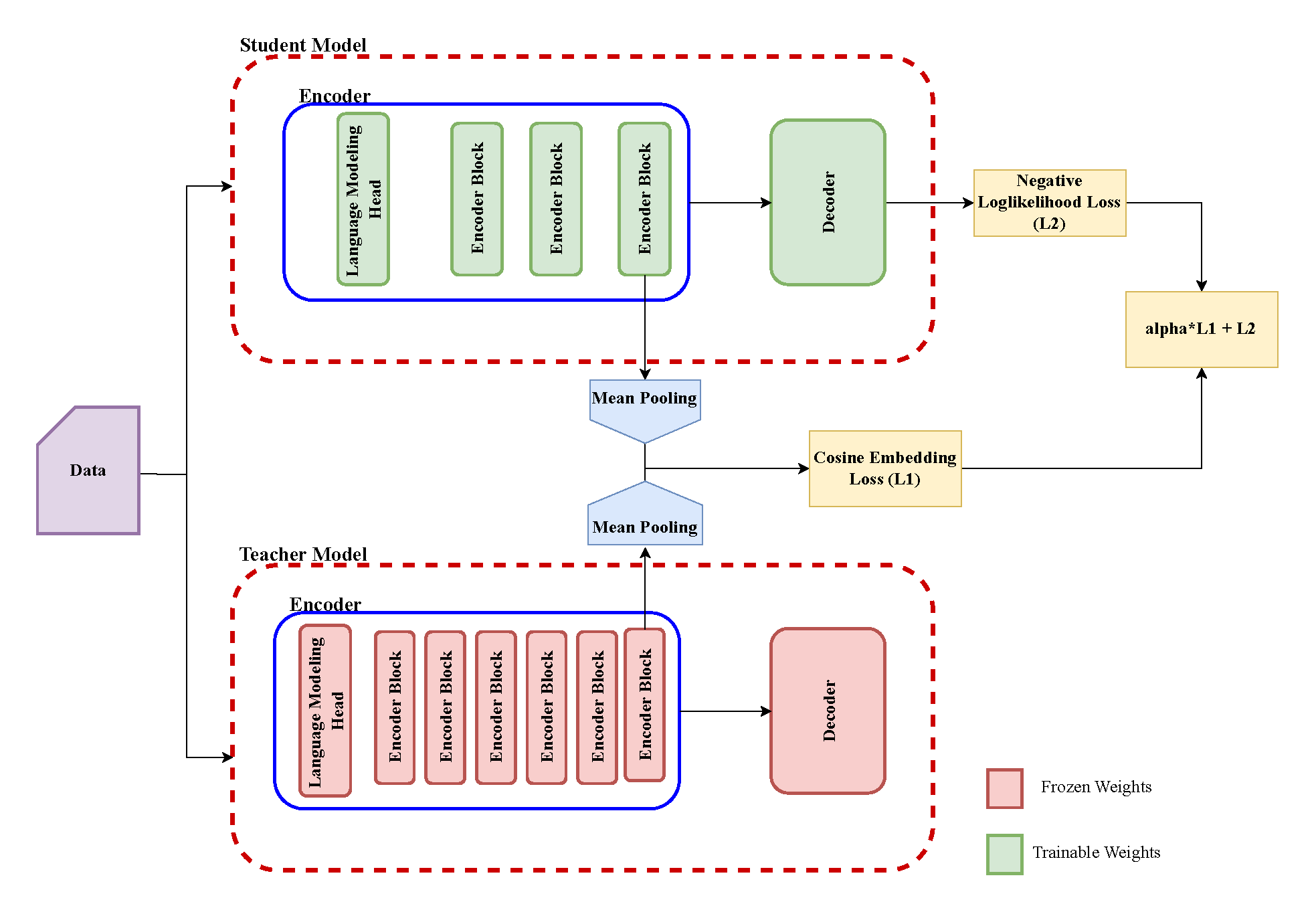
Domain adaptation in Neural Machine Translation (NMT) is commonly achieved through fine-tuning, but this approach becomes inefficient as the number of domains increases. Knowledge distillation (KD) provides a scalable alternative by training a compact model on distilled data from a larger model. However, we hypothesize that vanilla sequence-level KD primarily distills the decoder while neglecting encoder knowledge, leading to suboptimal knowledge transfer and limiting its effectiveness in low-resource settings, where both data and computational resources are constrained. To address this, we propose an improved sequence-level KD method that enhances encoder knowledge transfer through a cosine-based alignment loss. Our approach first trains a large model on a mixed-domain dataset and generates a Distilled Mixed Dataset (DMD). A small model is then trained on this dataset via sequence-level KD with encoder alignment. Experiments in a low-resource setting validate our hypothesis, demonstrating that our approach outperforms vanilla sequence-level KD, improves generalization to out-of-domain data, and facilitates efficient domain adaptation while reducing model size and computational cost.
@inproceedings{velayuthan2025encoder,
  title={{Encoder-Aware Sequence-Level Knowledge Distillation for Low-Resource Neural Machine Translation}},
  author={Velayuthan, Menan and De Silva, Nisansa and Ranathunga, Surangika},
  booktitle={Proceedings of the Eighth Workshop on Technologies for Machine Translation of Low-Resource Languages (LoResMT 2025)},
  pages={161--170},
  year={2025},
abstract={Domain adaptation in Neural Machine Translation (NMT) is commonly achieved through fine-tuning, but this approach becomes inefficient as the number of domains increases. Knowledge distillation (KD) provides a scalable alternative by training a compact model on distilled data from a larger model. However, we hypothesize that vanilla sequence-level KD primarily distills the decoder while neglecting encoder knowledge, leading to suboptimal knowledge transfer and limiting its effectiveness in low-resource settings, where both data and computational resources are constrained. To address this, we propose an improved sequence-level KD method that enhances encoder knowledge transfer through a cosine-based alignment loss. Our approach first trains a large model on a mixed-domain dataset and generates a Distilled Mixed Dataset (DMD). A small model is then trained on this dataset via sequence-level KD with encoder alignment. Experiments in a low-resource setting validate our hypothesis, demonstrating that our approach outperforms vanilla sequence-level KD, improves generalization to out-of-domain data, and facilitates efficient domain adaptation while reducing model size and computational cost.},
url={https://aclanthology.org/2025.loresmt-1.15.pdf},
misc={https://aclanthology.org/2025.loresmt-1.15.pdf,NLP:SIN:ML,https://goo.gl/iY6aTr}
}
Acknowledgement
This work was partially supported by the following grants:
2022
08
-
2025
12
Multi-domain Neural Machine Translation (NMT) System for Sinhala, Tamil, and English
$35,000 - Google/2022
We propose to create a multi-domain Neural Machine Translation (NMT) System for Sinhala, Tamil, and English, the official languages of Sri Lanka.


 Active

