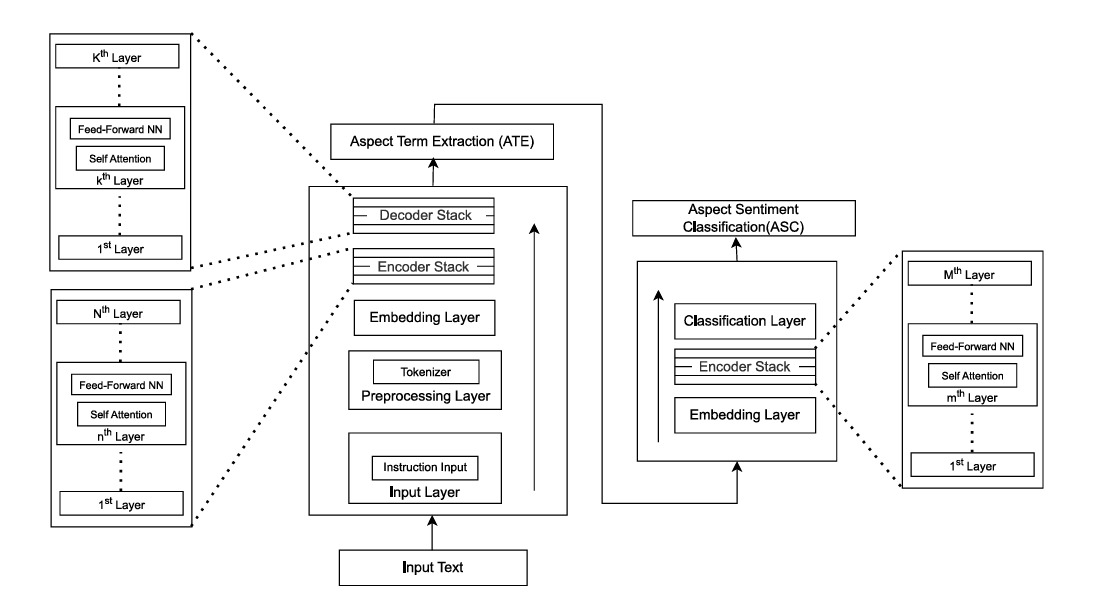
Aspect-based Sentiment Analysis (ABSA) is a critical task in Natural Language Processing (NLP) that focuses on extracting sentiments related to specific aspects within a text, offering deep insights into customer opinions. Traditional sentiment analysis methods, while useful for determining overall sentiment, often miss the implicit opinions about particular product or service features. This paper presents a comprehensive review of the evolution of ABSA methodologies, from lexicon-based approaches to machine learning and deep learning techniques. We emphasize the recent advancements in Transformer-based models, particularly Bidirectional Encoder Representations from Transformers (BERT) and its variants, which have set new benchmarks in ABSA tasks. We focused on finetuning Llama and Mistral models, building hybrid models using the SetFit framework, and developing our own model by exploiting the strengths of state-of-the-art (SOTA) Transformer-based models for aspect term extraction (ATE) and aspect sentiment classification (ASC). Our hybrid model Instruct - DeBERTa uses SOTA InstructABSA for aspect extraction and DeBERTa-V3-baseabsa-V1 for aspect sentiment classification. We utilize datasets from different domains to evaluate our model's performance. Our experiments indicate that the proposed hybrid model significantly improves the accuracy and reliability of sentiment analysis across all experimented domains. As per our findings, our hybrid model Instruct - DeBERTa is the best-performing model for the joint task of ATE and ASC for both SemEval restaurant 2014 and SemEval laptop 2014 datasets separately. By addressing the limitations of existing methodologies, our approach provides a robust solution for understanding detailed consumer feedback, thus offering valuable insights for businesses aiming to enhance customer satisfaction and product development.
@article{jayakody2025instruct,
  title={{Instruct-DeBERTa: A Hybrid Approach for Aspect-based Sentiment Analysis on Textual Reviews}},
  author={Jayakody, Dineth and Malkith, A V A and Isuranda, Koshila and Thenuwara, Vishal and de Silva, Nisansa and Ponnamperuma, Sachintha Rajith and Sandamali, G G N and Sudheera, K L K},
  journal={ICTer},
abstract={Aspect-based Sentiment Analysis (ABSA) is a critical task in Natural Language Processing (NLP) that focuses on extracting sentiments related to specific aspects within a text, offering deep insights into customer opinions. Traditional sentiment analysis methods, while useful for determining overall sentiment, often miss the implicit opinions about particular product or service features. This paper presents a comprehensive review of the evolution of ABSA methodologies, from lexicon-based approaches to machine learning and deep learning techniques. We emphasize the recent advancements in Transformer-based models, particularly Bidirectional Encoder Representations from Transformers (BERT) and its variants, which have set new benchmarks in ABSA tasks. We focused on finetuning Llama and Mistral models, building hybrid models using the SetFit framework, and developing our own model by exploiting the strengths of state-of-the-art (SOTA) Transformer-based models for aspect term extraction (ATE) and aspect sentiment classification (ASC). Our hybrid model Instruct - DeBERTa uses SOTA InstructABSA for aspect extraction and DeBERTa-V3-baseabsa-V1 for aspect sentiment classification. We utilize datasets from different domains to evaluate our model's performance. Our experiments indicate that the proposed hybrid model significantly improves the accuracy and reliability of sentiment analysis across all experimented domains. As per our findings, our hybrid model Instruct - DeBERTa is the best-performing model for the joint task of ATE and ASC for both SemEval restaurant 2014 and SemEval laptop 2014 datasets separately. By addressing the limitations of existing methodologies, our approach provides a robust solution for understanding detailed consumer feedback, thus offering valuable insights for businesses aiming to enhance customer satisfaction and product development.},
  year={2025},
 volume={18},
  number={2},
doi={10.4038/icter.v18i2.7290},
pages={39-50},
misc={https://arxiv.org/abs/2408.13202,NLP,https://goo.gl/iY6aTr}
}

 Active