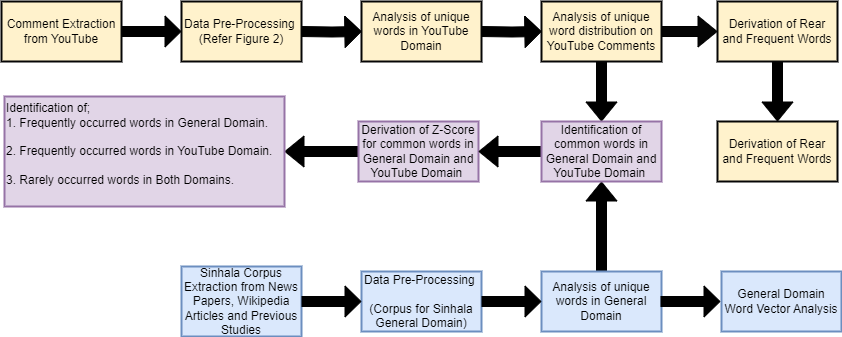
This research investigates the area of Music Information Retrieval (MIR) and Music Emotion Recognition (MER) in relation to Sinhala songs, an underexplored field in music studies. The purpose of this study is to analyze the behavior of Sinhala comments on YouTube Sinhala song videos using social media comments as primary data sources. These included comments from 27 YouTube videos containing 20 different Sinhala songs, which were carefully selected so that strict linguistic reliability would be maintained and relevancy ensured. This process led to a total of 93,116 comments being gathered upon which the dataset was refined further by advanced filtering methods and transliteration mechanisms resulting into 63,471 Sinhala comments. Additionally, 964 stop-words specific for the Sinhala language were algorithmically derived out of which 182 matched exactly with English stop-words from NLTK corpus once translated. Also, comparisons were made between general domain corpora in Sinhala against the YouTube Comment Corpus in Sinhala confirming latter as good representation of general domain. The meticulously curated data set as well as the derived stop-words form important resources for future research in the fields of MIR and MER, since they could be used and demonstrate that there are possibilities with computational techniques to solve complex musical experiences across varied cultural traditions.
@article{de2025linguistic,
  title={{Linguistic Analysis of Sinhala YouTube Comments on Sinhala Music Videos: A Dataset Study}},
  author={De Mel, W M Yomal and de Silva, Nisansa},
  journal={ICTer},
 pages={121-130},
  year={2025},
abstract={This research investigates the area of Music Information Retrieval (MIR) and Music Emotion Recognition (MER) in relation to Sinhala songs, an underexplored field in music studies. The purpose of this study is to analyze the behavior of Sinhala comments on YouTube Sinhala song videos using social media comments as primary data sources. These included comments from 27 YouTube videos containing 20 different Sinhala songs, which were carefully selected so that strict linguistic reliability would be maintained and relevancy ensured. This process led to a total of 93,116 comments being gathered upon which the dataset was refined further by advanced filtering methods and transliteration mechanisms resulting into 63,471 Sinhala comments. Additionally, 964 stop-words specific for the Sinhala language were algorithmically derived out of which 182 matched exactly with English stop-words from NLTK corpus once translated. Also, comparisons were made between general domain corpora in Sinhala against the YouTube Comment Corpus in Sinhala confirming latter as good representation of general domain. The meticulously curated data set as well as the derived stop-words form important resources for future research in the fields of MIR and MER, since they could be used and demonstrate that there are possibilities with computational techniques to solve complex musical experiences across varied cultural traditions.},
  doi={10.4038/icter.v18i2.7299},
 volume={18},
  number={2},
misc={https://arxiv.org/abs/2501.18633,NLP:SIN,https://goo.gl/iY6aTr}
}

 Active