LLM Multi-agent Systems
Principal Investigator: Nisansa de Silva
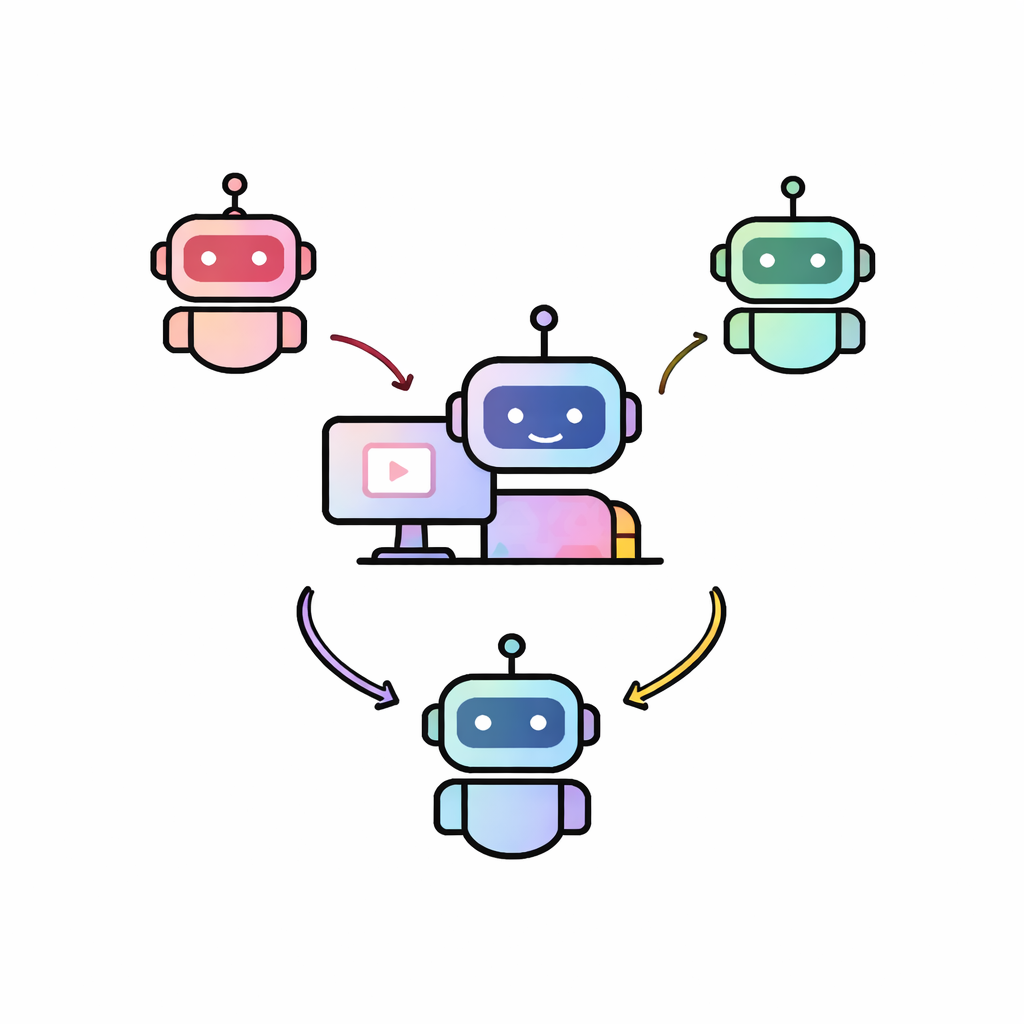
The LLM Multi-agent Systems project explores how large language models can be coordinated as interacting agents to perform complex reasoning, cooperation, and task execution in natural language environments.
The LLM Multi-agent Systems project explores how large language models can be coordinated as interacting agents to perform complex reasoning, cooperation, and task execution in natural language environments. Recent advances in large language models have enabled the creation of agents capable of social reasoning and decision-making, opening new opportunities to study collective behaviour and cooperative dynamics in multi-agent systems.
One research direction investigates whether cooperation mechanisms predicted by classical theoretical models can emerge when agents are implemented using language models. By simulating strategic interactions such as the diner’s dilemma, language-model-based agents engage in natural language reasoning while adopting strategies and imitating behaviours of other agents. Experimental results show that cooperative norms can emerge in these environments, particularly when mechanisms such as punishment and imitation are introduced, demonstrating that language-driven agents can reproduce and extend insights from traditional mathematical models of cooperation.
Another research direction focuses on practical applications of language-model-driven agents through the development of a multi-agent calendar assistant capable of managing user schedules through natural language. The system coordinates specialised agents through a structured supervisory mechanism that interprets user requests, resolves conflicts, and manages calendar operations. Together, these studies highlight how multi-agent architectures powered by language models can support both scientific investigations of social behaviour and the development of intelligent, collaborative digital assistants.
Objectives:
- Investigate cooperative behaviour in language model agents by simulating strategic interactions in multi-agent environments and analysing whether cooperative norms predicted by classical theoretical models emerge through natural language reasoning.
- Develop and evaluate multi-agent system architectures powered by language models, focusing on mechanisms such as agent coordination, strategy adaptation, and structured communication between specialised agents.
- Design practical multi-agent applications that use natural language interfaces to assist users with complex tasks, demonstrating how coordinated language model agents can improve usability and automation in real-world systems.
- Assess the effectiveness of language-model-based multi-agent systems as realistic simulation environments for studying social dynamics, decision-making, and cooperation compared to traditional mathematical or rule-based agent models.
Keywords: Natural Language Processing | Machine Learning / Deep Learning | Sinhala |
Publications
Conference Papers
Kavindu Warnakulasuriya, Prabhash Dissanayake, Navindu De Silva, Stephen Cranefield, Bastin Tony Roy Savarimuthu, Surangika Ranathunga, and Nisansa de Silva, "Evolution of Cooperation in LLM-Agent Societies: A Preliminary Study Using Different Punishment Strategies", in Coordination, Organizations, Institutions, Norms, and Ethics for Governance of Multi-Agent Systems XVIII, Springer Nature Switzerland, 2026, pp. 115--133. doi: 10.1007/978-3-032-17542-7_7
Oshadha Wijerathne, Amandi Nimasha, Dushan Fernando, Nisansa de Silva, and Srinath Perera, "ScheduleMe: Multi-Agent Calendar Assistant", in Proceedings of the 39th Pacific Asia Conference on Language, Information and Computation, 2025, pp. 309--319.
Team
External Collaborators: | Srinath Perera | Stephen Cranefield | Bastin Tony Roy Savarimuthu | Surangika Ranathunga |